Introduction
The Design-out-Waste (DoW) approach represents a pathway for achieving circularity in the building sector by embedding waste reduction in design practices. DoW strategies aim to reduce material waste production and enhance resource efficiency throughout the building lifecycle by engaging in five key concepts: efficient procurement, materials optimisation, off-site construction, reuse and recovery, and design for deconstruction.
The systemic adoption of DoW strategies has the potential to achieve the transition to a circular economy and promote regenerative design practices in the building sector. This tool provides a maturity model to facilitate the transition of design firms in implementing the DoW.

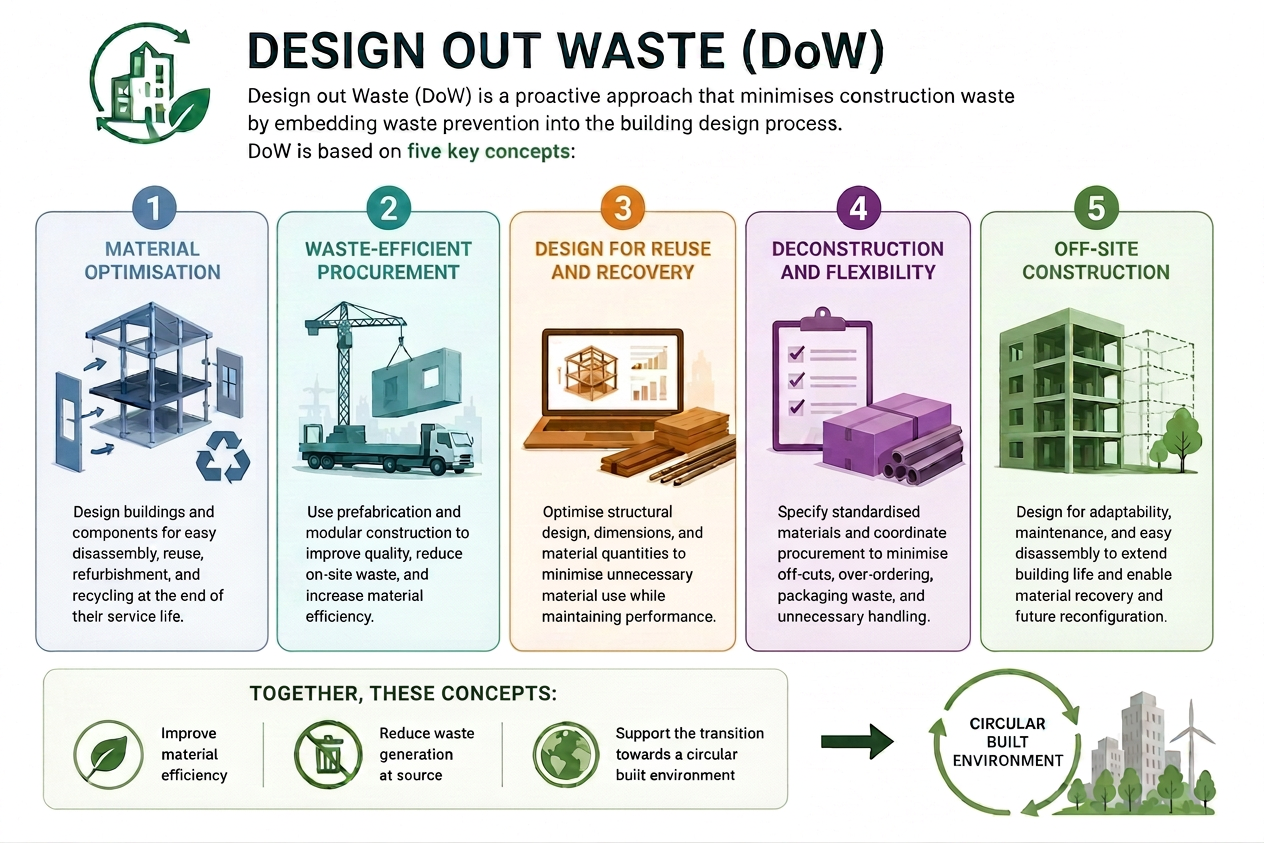
DoW Key Concepts
Design-out-Waste (DoW) is a key enablers of the Circular (CE) in construction. By preventing waste during the design stage and promoting reuse, material efficiency, prefabrication, and design for deconstruction, DoW reduces resource consumption, extends the life of building components, and supports the transition from a linear to a circular built environment.
Why is a maturity model needed?
The five Design-out-Waste (DoW) key concepts provide clear guidance for reducing construction waste. However, successful implementation depends not only on technical design decisions but also on organisational capability. Effective DoW requires appropriate processes, skilled people, supportive industry conditions, enabling technologies, and strategic commitment. Since organisations adopt these capabilities at different stages of development, a structured maturity model is needed to assess current performance, identify capability gaps, and provide a roadmap for continuous improvement towards systematic DoW implementation.

Successful Design-out-Waste (DoW) implementation requires more than technical solutions. Sustainable implementation depends on organisational capabilities that integrate processes, people, industry collaboration, technology, and strategic commitment, providing the foundation for progressive maturity development.
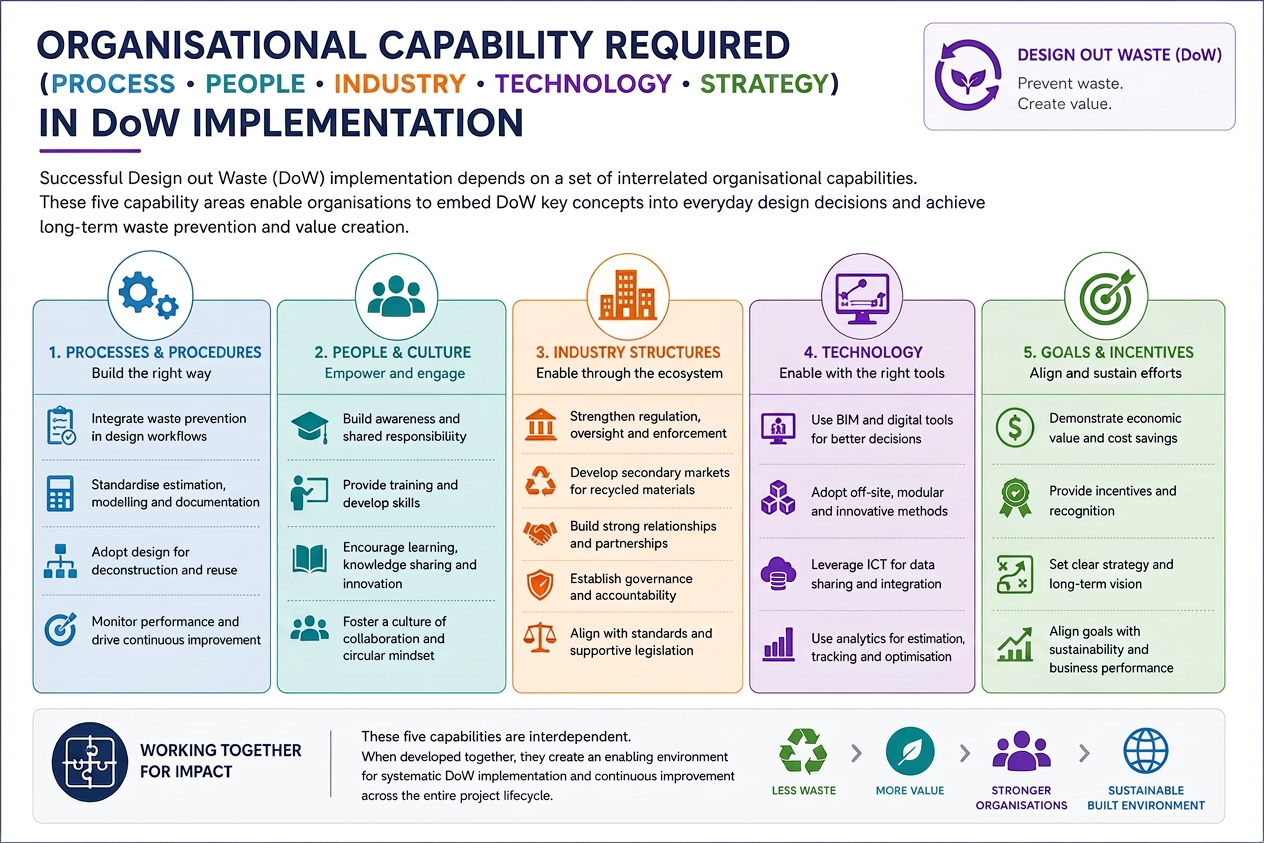
DoW Maturity Model
Maturity is represented through five progressive levels (Initial, Managed, Standardised, Integrated, and Optimised) reflecting the gradual development from ad hoc practices to organisation-wide, continuously improved DoW implementation. The table below outlines the expected characteristics of each attribute at every maturity level, providing practical guidance for organisations to benchmark their current practices, identify areas for improvement, and plan their progression towards more effective and circular design practices.
Design-out-Waste (DoW) Maturity Model – 17 x 5 = 85 indicators
|
5 Dimension & 17 Attributes |
LEVEL 1 | LEVEL 2 | LEVEL 3 | LEVEL 4 | LEVEL 5 |
|---|---|---|---|---|---|
|
Processes & Procedures:
A1: Technical Process,A2: Environmental Strategies, A3: Product & Service |
A1.1: No waste estimation; considered late; and conventional methods. A2.1: Compliance-driven actions; no lifecycle assessment; and recycling reactive. A3.1: Aesthetic priorities dominate; reuse neglected; and waste reduction marginalised. |
A1.2: Selective estimation; partial discussion; and modern methods used occasionally. A2.2: Selective environmental consideration; partial lifecycle assessment; and project-based circularity. A3.2: Selective optimisation; limited reuse; and waste minimisation optional. |
A1.3: Structured procedures; routine modular coordination; and standard estimation embedded. A2.3: Integrated lifecycle evaluation; circular design; and formal policy objectives. A3.3: Deconstruction, reuse, and efficient detailing embedded standard practice. |
A1.4: Waste performance reviewed; modular optimisation; and predictive digital tools. A2.4: Metric-based carbon management; circular optimisation; and integrated decision targets. A3.4: Modular recovery, circular advisory, and digital optimisation integrated. |
A1.5: Corporate standards institutionalise circular design and analytics. A2.5: Firm-wide benchmarking; closed-loop strategy; corporate-driven DoW. A3.5: Lifecycle recovery, circular strategy, and benchmarking embedded firm-wide. |
|
People & Culture:
A4: Social Responsibility & Awareness,A5: Training Program, A6: Education System & Research |
A4.1: Awareness team-specific; informal responsibility; and innovation emerging. A5.1: No training; low-waste knowledge lacking; and skills unevaluated. A6.1: No academic collaboration; no structured DoW; and rare innovation. |
A4.2: Team-level awareness; informal responsibility; and emerging innovation. A5.2: Informal training; selective MMC skills; and occasional review. A6.2: Occasional collaboration; informal knowledge sharing; and isolated innovation. |
A4.3: Circular thinking encouraged; roles defined; and awareness cross-departmental. A5.3: Regular evaluation; structured training; and DoW programmes implemented. A6.3: Internal knowledge systems; research adoption; formal exchange partnerships. |
A4.4: Circular behaviour reinforced; responsibilities integrated; and reporting structured. A5.4: Performance-informed training; circular methods integrated; and advanced. A6.4: Research integrated; digital circular innovation; and collaborative DoW. |
A4.5: Circular mindset institutionalised; accountability embedded; and sustainability identity firm-wide. A5.5: Portfolio lifecycle optimisation and closed-loop sustainability drives DoW. A6.5: Knowledge systems, partnerships, and leadership institutionalise DoW innovation. |
|
Industry Structures:
A7: Governmental Supervision,A8: Secondary Market of Recycled Materials, A9: Relationship & Partnership, A10: Organisational Governance, A11: Legislation |
A7.1: Limited oversight; inconsistent enforcement; and compliance-focused supervision. A8.1: Inaccessible recycled market; supplier barriers; and fragmentation. A9.1: Siloed departments; minimal coordination; and no circular partnerships. A10.1: No DoW tracking, governance, or leadership engagement. A11.1: No statutory design mandate; disposal-focused legislation; and no innovation support. |
A7.2: Occasional inspections; basic enforcement; and limited reduction encouragement. A8.2: Limited supply; weak networks; and unreliable emerging market. A9.2: Informal coordination; project-based collaboration; and temporary sustainability partnerships. A10.2: Informal monitoring; selective governance; and limited managerial support. A11.2: Non-binding clauses; indirect design influence; and limited regulatory flexibility. |
A7.3: Structured policies; regular enforcement; and formal inspection procedures. A8.3: Structured market; reliable suppliers; and recycled materials selectively available. A9.3: Formal partnerships; coordinated supply chain; and structured cross-functional collaboration. A10.3: Executive endorsement; formal standards; and structured reporting systems. A11.3: Standards promote prefabrication, modularity, and design-based reduction. |
A7.4: Circular-aligned supervision; active enforcement; systematic monitoring. A8.4: Stable markets; integrated supply chains; secondary markets inform design. A9.4: Strategic circular partnerships; integrated planning; defined collaboration protocols. A10.4: Strategic leadership alignment; integrated governance; and systematic KPI monitoring. A11.4: Regulations mandate innovative, design-stage waste prevention. |
A7.5: Nationally aligned supervision; institutional enforcement; data-driven monitoring. A8.5: Institutionalised ecosystem; seamless supply chains; mainstream circular markets. A9.5: Industry-wide networks; embedded supply chains; firm-wide circular collaboration. A10.5: Institutionalised governance drives circular innovation and optimisation. A11.5: Adaptive legislation institutionalises lifecycle-wide and inception-stage DoW compliance. |
|
Technology:
A12: Technology Infrastructure,A13: Innovative Construction Methods, A14: Information & Communication Technology |
A12.1: No structured digital system; isolated tools; no DoW analytics. A13.1: Conventional methods dominate; no innovation guidance; and short-term focus. A14.1: No ICT, no data sharing, and no feedback. |
A12.2: Basic estimation tools; limited use; weak interoperability. A13.2: Isolated innovation; project experimentation; and limited downstream consideration. A14.2: Basic ICT supports limited sharing and review. |
A12.3: Integrated modelling-estimation; structured analytics; standardised quantification. A13.3: Guided prefabrication reduces on-site waste in projects. A14.3: Structured ICT reporting supports periodic optimisation. |
A12.4: Integrated platforms; predictive modelling; cross-project material-carbon management. A13.4: Standardised modular methods aligned with material recovery principles. A14.4: Integrated ICT enables cross-project waste optimisation. |
A12.5: Scalable interoperable infrastructure; advanced analytics optimise firm-wide. A13.5: Firm-wide lifecycle-optimised modular construction systems. A14.5: Firm-wide institutionalised data-driven DoW optimisation. |
|
Goals & Incentives:
A15: Economic Viability,A16: Incentives, A17: Strategy & Vision |
A15.1: DoW perceived as cost, without financial evaluation or measurable return. A16.1: No formal incentives applied, monitored, or influencing DoW performance. A17.1: Segregation, durable/local materials, and documentation applied reactively and in isolation. |
A15.2: Economic potential selectively recognised, with basic evaluation and inconsistent financial gains. A16.2: Ad hoc incentives inconsistently applied with limited monitoring impact. A17.2: Selective Modern Methods of Construction, estimation, and deconstruction in strategy. |
A15.3: Project-level economic value demonstrated through structured assessment and organisational recognition. A16.3: Formal incentives consistently applied with basic monitoring. A17.3: Strategic DoW supports prefabrication, reuse, flexibility. |
A15.4: Financial returns tracked, modelled, and formally recognised organisation-wide. A16.4: Incentives formally integrated, monitored, and aligned with DoW targets. A17.4: Integrated modular, logistics, carbon, and recycling strategy. |
A15.5: DoW strategically optimises long-term economic performance and competitiveness. A16.5: Firm-wide institutionalised incentives drive continuous DoW optimisation. A17.5: Lifecycle-optimised maintenance, sizing, layout, recovery institutionalised. |